
- Tips
- technology
- Frequently Asked Questions
- Tests
- mAh capacity
- Rated Capacity
- comparison
- everActive
- Batteries vs rechargeable batteries
- Accumulated energy
- Durability of rechargeable batteries
- Efficiency of rechargeable batteries
- battery voltage
- LR03 AAA
- LR6 AA
- eneloop
- AG13 LR1154 LR44
- CR 2032
- Delta V
- Charge Cycles
- internal resistance
- charge level
- memory effect
- accredited test
- SR44 357
- Hearing Batteries 675
- SR626 377
- Watch Batteries
- Polarity
- Mah
- passivation
- LS 14250
- LS 14500
Great test of 9V batteries, comparison of technologies: alkaline vs Ni-MH vs Li-ion, which is the best?



This time in our lab, we decided to thoroughly test the capabilities of block alkaline batteries, Ni-MH rechargeable batteries, and Li-ion in the 9V size (the designation for the alkaline battery is 6LR61).
The test involved measuring capacity, energy, and recording discharge curves at currents of 50 mA, 100 mA, 200 mA, and 500 mA.
The participants in our test are: Varta Industrial alkaline batteries, Energizer 175 mAh Ni-MH rechargeable battery, everActive Professional Line 280 mAh Ni-MH rechargeable battery, and everActive Professional+ Lithium 500 mAh Li-ion rechargeable battery.
Looking for a 9V battery? Consider the available options in the store at hurt.com.pl
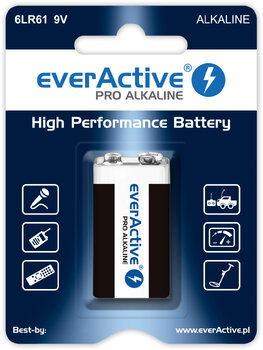
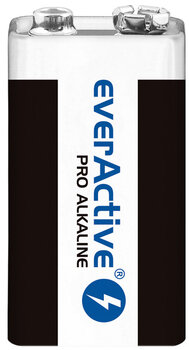
1 x 6LR61 9V battery (R9*) everActive Pro Alkaline (blister)
- PRO ALKALINE is the highest line of alkaline batteries for professional applications
- capacity approx. 650 mAh
- expiry date - 10 years from the production date
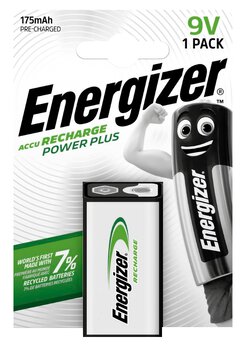
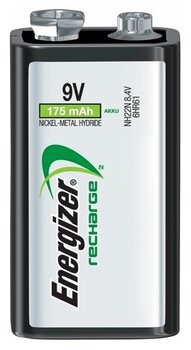
1 x 6F22/9V Energizer Ni-MH battery 175mAh 8.4V
- capacity: 175 mAh
- voltage [V]: 8.4
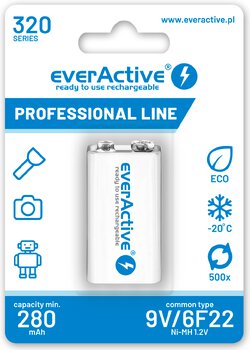
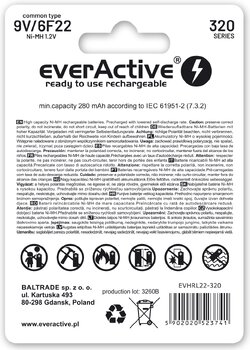
1 x 6F22/9V everActive Ni-MH 320 mAh rechargeable battery ready to use "Professional line"
- the most powerful Ni-MH battery on the market in 9V size
- 1pc - factory consumer packaging - blister
- tested performance - real capacity
- battery pre-charged, new generation made with Ready To Use technology
- highest quality of batteries confirmed by numerous tests
Product presentation, test objective
For the tests, we selected well-known, proven, and valued batteries and accumulators in the 9V size. They were made using various technologies. We hope that the results will allow for the selection of the appropriate solution for the device you have.
Which battery, of which chemistry, lasts the longest? Which delivers the most energy? Does an alkaline battery offer a higher voltage than accumulators? You will find answers to all of this in our test.
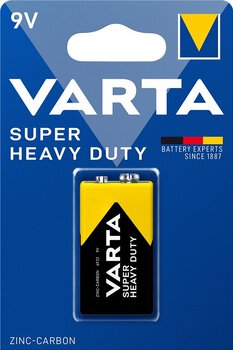
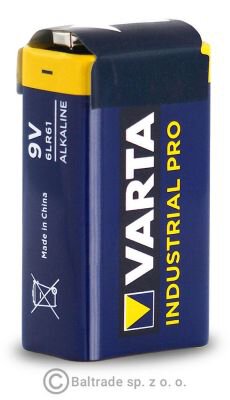
1. Varta Industrial Pro Alkaline 9V 6LR61
Manufacturer data:
- chemistry: Zn-MnO2 (alkaline)
- nominal voltage: 9V
- capacity: 640 mAh (load 620 Ohm to 5.4V)
- energy: 4915 mWh (load 620 Ohm to 5.4V)
2. Energizer Ni-MH 8.4V Battery
Manufacturer data:
- chemistry: Ni-MH (nickel-metal hydride)
- nominal voltage: 8.4V
- capacity: 175 mAh (load 35 mA to 7V)
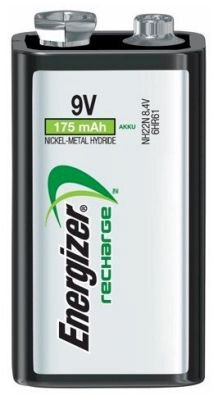
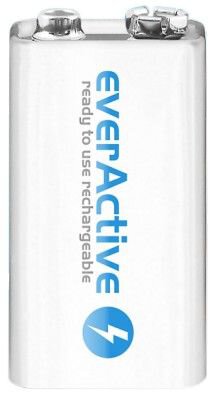
3. everActive Professional Line Ni-MH 8.4V Battery
Manufacturer data:
- chemistry: Ni-MH (nickel-metal hydride)
- nominal voltage: 8.4V
- capacity: 280 mAh (load 56 mA to 7V)
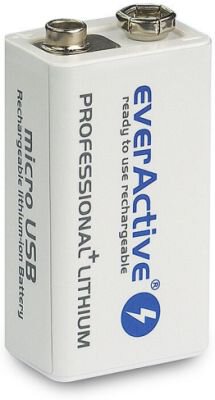
4. everActive Professional+ Lithium Li-ion 7.4V Battery
Manufacturer data:
- chemistry: Li-ion (lithium-ion)
- nominal voltage: 7.4V
- capacity: 500 mAh (load 100 mA to 6V)
Comparing the raw technical data, one might get the impression that the alkaline battery dominates over the accumulators with a higher capacity and higher nominal voltage, so it should work the longest/safest - but is that really the case?
Testing Procedure
For the tests, we used 4 pieces of alkaline batteries and one piece of each accumulator. The accumulators were conditioned before the tests by 3 full charge and discharge cycles.
The tests involved discharging at room temperature with currents of: 50 mA, 100 mA, 200 mA, and 500 mA. The measurement uncertainty in our test was 2%.
Based on the recorded measurements, the capacity [mAh], energy [mWh], and internal resistance [mOhm] of all cells were calculated.
We established a total discharge threshold of 4V - this is the critical voltage at which many multimeters refuse to work, etc.
Test No. 1 - Discharge at 50 mA
A current of 50 mA is a moderate value for 9V batteries. Many devices in pulse mode require higher values, but in many applications (most electronic multimeters) the needs are much lower. We considered this a good starting point for further, more demanding tests.
To start, here are the raw results - we remind you that the critical discharge threshold was reaching a voltage of 4.0V.
Capacity:
1. Alkaline battery: 598 mAh
2. Li-ion battery: 530 mAh
3. Ni-MH 280 battery: 316 mAh
4. Ni-MH 175 battery: 196 mAh
Energy:
1. Alkaline battery: 4331 mWh
2. Li-ion battery: 3946 mWh
3. Ni-MH 280 battery: 2731 mWh
4. Ni-MH 175 battery: 1719 mWh
Note that although the alkaline battery clearly wins in the capacity test, it is not so convincing when we take into account the accumulated energy in mWh.
The mAh capacity is a unit that we should only compare for cells with exactly the same output voltage, made with the same technology - the voltage of the battery during operation does not affect its value. The actual performance of the battery is much more accurately defined by the energy expressed in mWh - its value takes into account the output voltage of the given battery during operation.
Average voltage:
1. Ni-MH 175 battery: 8.75V
2. Ni-MH 280 battery: 8.64V
3. Li-ion battery: 7.43V
4. Alkaline battery: 7.24V
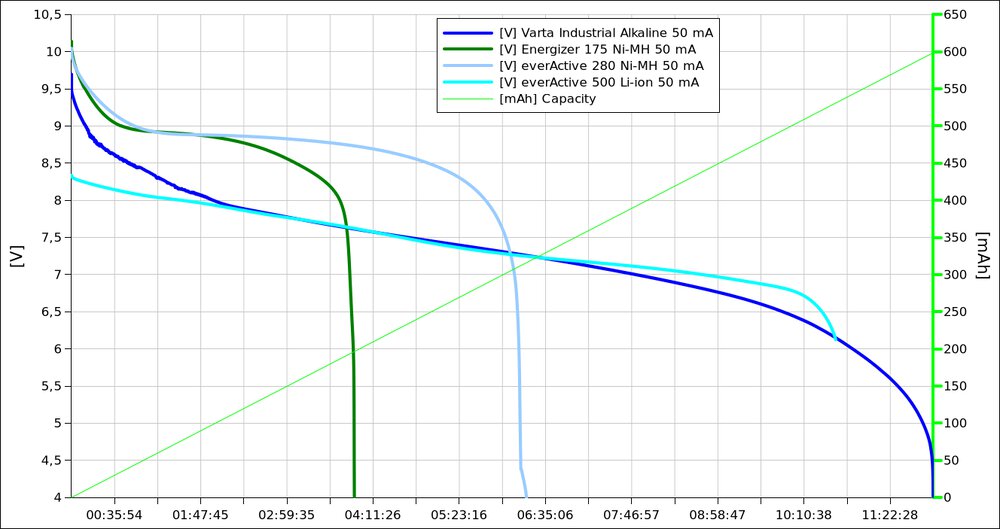
It turns out that the alkaline battery with the highest declared nominal voltage of 9V actually offers an output voltage close to that of the Li-ion 7.4V battery.
Ni-MH 8.4V accumulators offer significantly the highest output voltage.
Ultimately, under 50mA discharge conditions, down to 4.0V, the alkaline battery wins, but if our device required a voltage above 7.0V to operate, the alkaline battery would lose to the Li-ion accumulator, only slightly winning against the Ni-MH 280 accumulator. Below are graphs showing the dependencies of the achieved capacity and energy values on voltage.
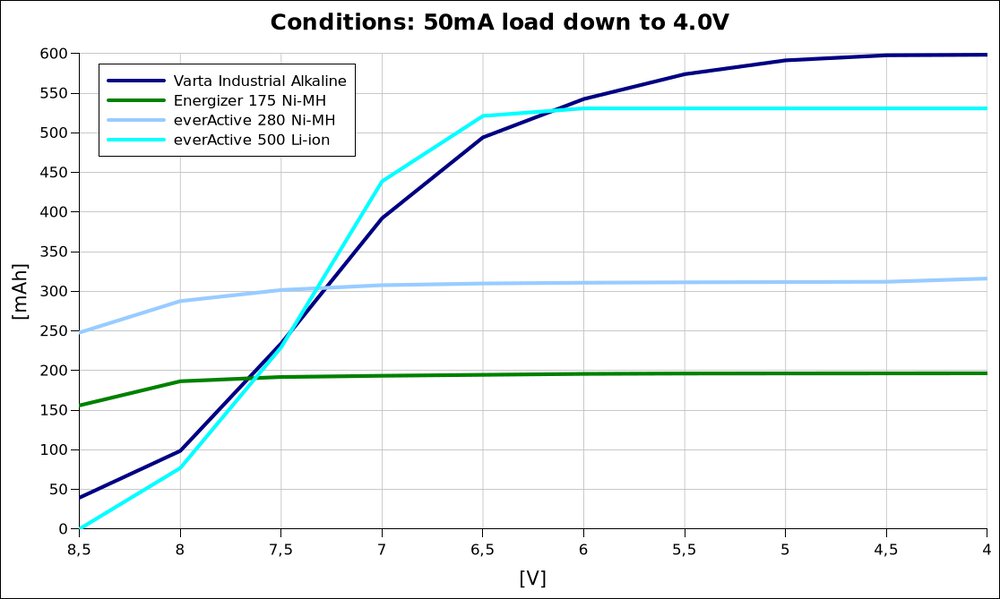
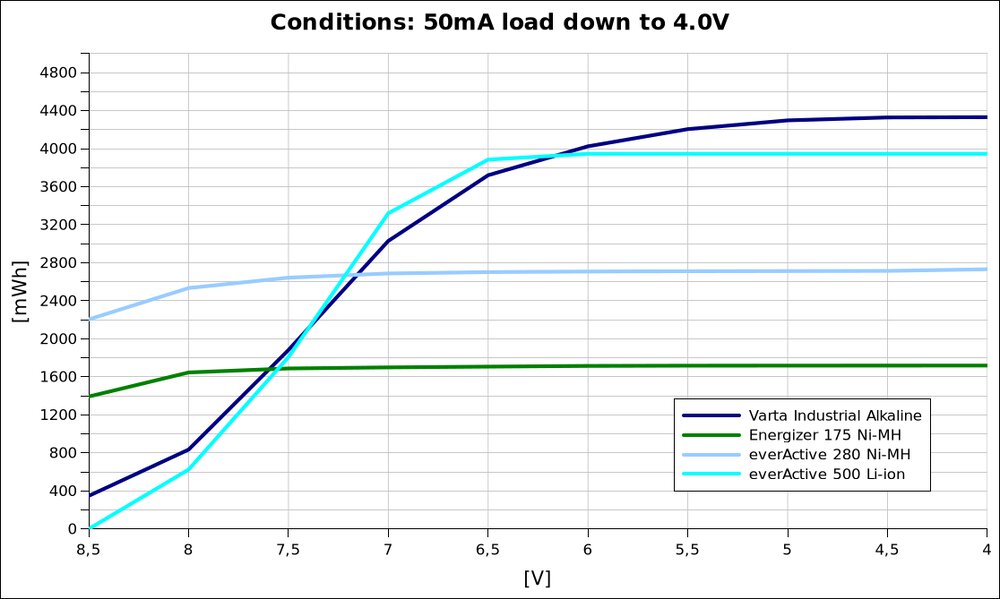
PS. The curious will note that the alkaline battery is the only one that did not achieve its declared capacity in this test - this is due to the fact that the 50 mA discharge current is still too high to meet this condition. The Varta alkaline battery achieves its declared capacity under a load of 620 Ohm, which can be related to a discharge current of about 10 mA. The higher the load, the more the usable capacity of the alkaline battery clearly decreases - this will be shown in further tests.
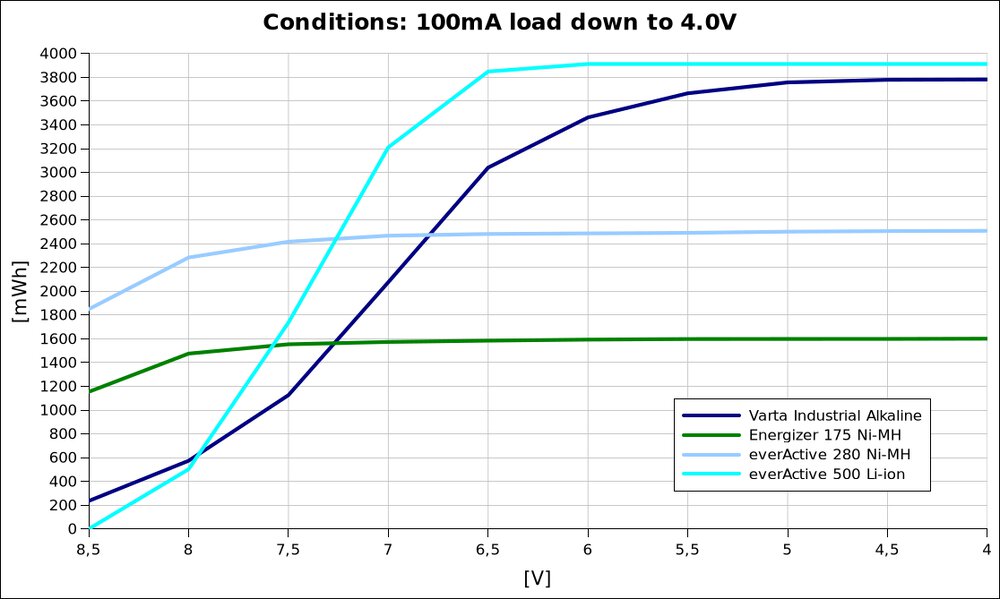
Test No. 2 - Discharge at 100 mA
The discharge current of 100 mA is still quite moderate for 9V batteries. Such consumption is characteristic of some non-contact thermometers, some toys, etc.
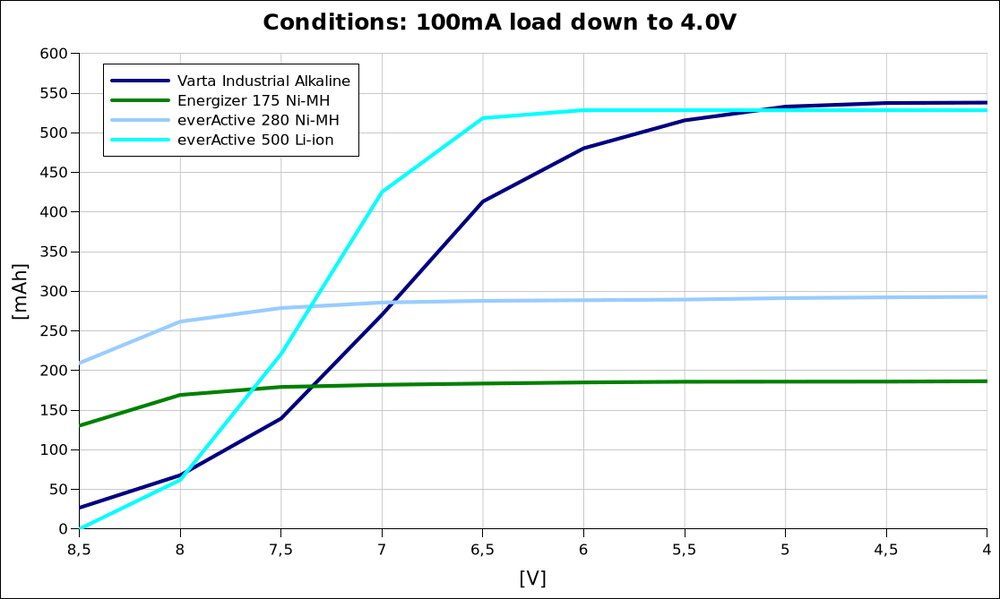
Capacity:
1. Alkaline battery: 538 mAh
2. Li-ion battery: 528 mAh
3. Ni-MH 280 battery: 293 mAh
4. Ni-MH 175 battery: 186 mAh
Energy:
1. Li-ion battery: 3912 mWh
2. Alkaline battery: 3782 mWh
3. Ni-MH 280 battery: 2508 mWh
4. Ni-MH 175 battery: 1601 mWh
Average voltage:
1. Ni-MH 175 battery: 8.59V
2. Ni-MH 280 battery: 8.56V
3. Li-ion battery: 7.40V
4. Alkaline battery: 7.03V
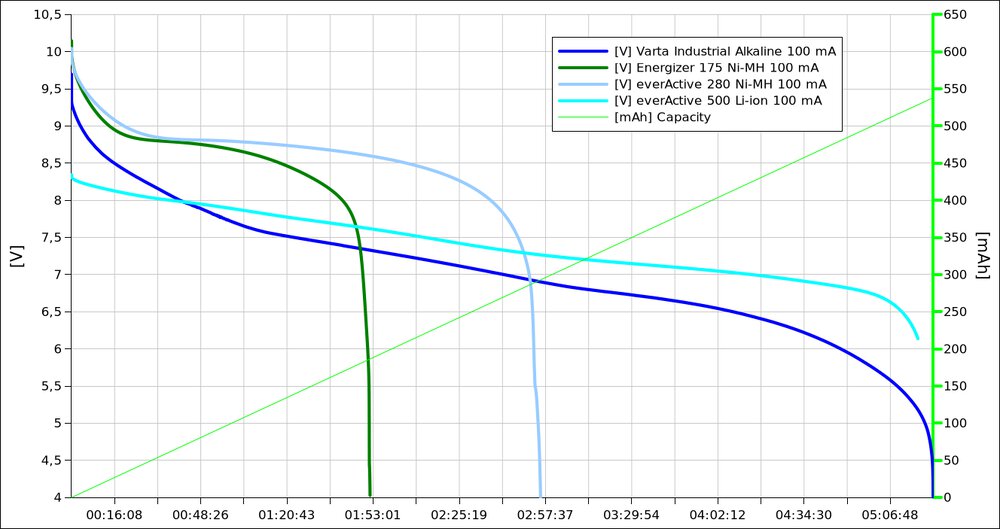
A load of 100 mA results in a significant drop in capacity achieved by alkaline batteries and an even greater loss in stored energy. All accumulators, on the other hand, offer very stable parameters, similar to those at a load of 50 mA.
It is hard to consider the alkaline battery a winner under 100 mA discharge conditions.
When discharging to a level of 7.0V, the alkaline battery clearly loses even to the Ni-MH 280 mAh accumulator (due to lower delivered power).
Below are graphs showing the dependencies of the achieved capacity and energy values on voltage.
Test No. 3 - Discharge at 200 mA
The discharge current of 200 mA is already quite demanding conditions for 9V batteries. However, there are still devices in use that have even greater instantaneous energy demands - e.g., paintball accessories, etc.
Capacity:
1. Li-ion battery: 526 mAh
2. Alkaline battery: 465 mAh
3. Ni-MH 280 battery: 288 mAh
4. Ni-MH 175 battery: 186 mAh
Energy:
1. Li-ion battery: 3854 mWh
2. Alkaline battery: 3158 mWh
3. Ni-MH 280 battery: 2399 mWh
4. Ni-MH 175 battery: 1543 mWh
Average voltage:
1. Ni-MH 280 battery: 8.34 V
2. Ni-MH 175 battery: 8.30 V
3. Li-ion battery: 7.33 V
4. Alkaline battery: 6.75 V
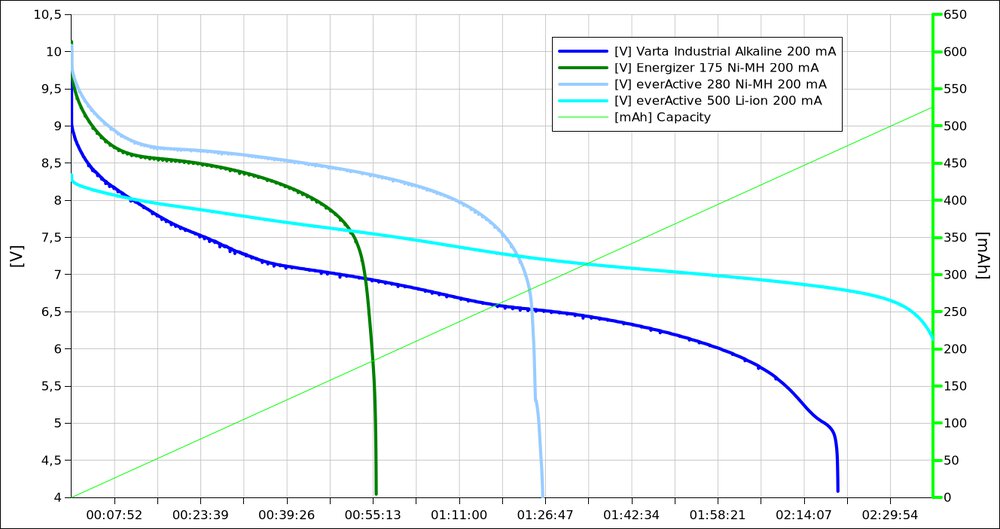
A load of 200 mA results in further drops in capacity and accumulated energy in the alkaline battery. All accumulators remain very stable. It is worth noting that Ni-MH accumulators have distinctly the highest output voltage in the entire group.
Below are graphs showing the dependencies of the achieved capacity and energy values on voltage.
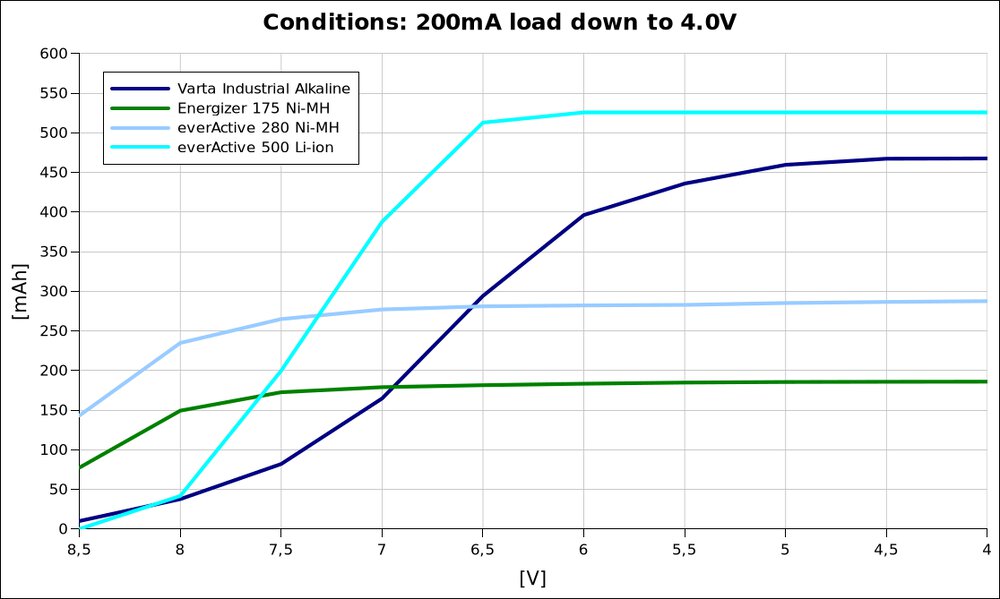
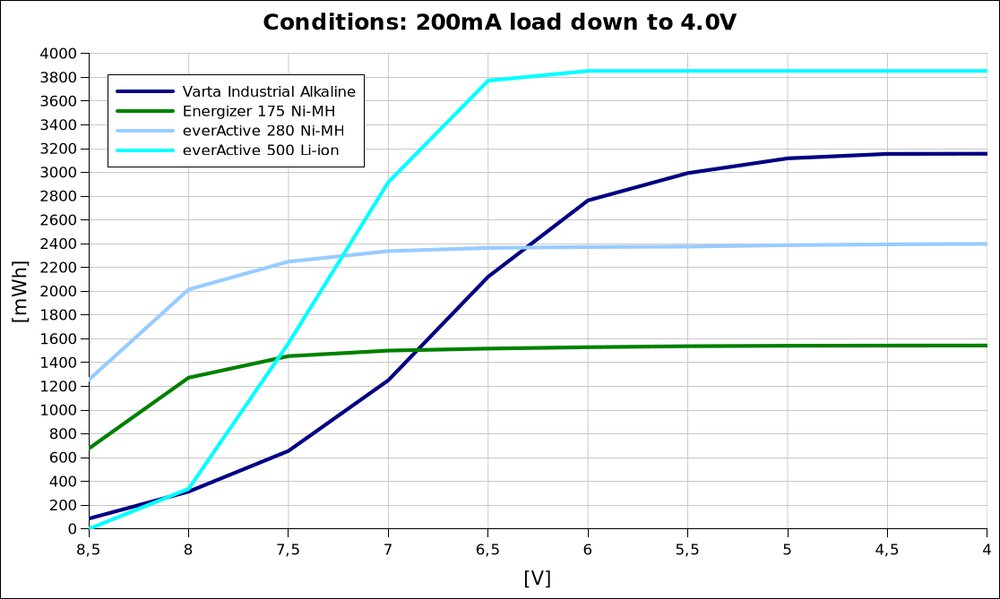
The winner under 200 mA discharge conditions is the everActive Li-ion accumulator.
When discharging to a level of 7.0V, the alkaline battery already loses even to the least capacious Ni-MH 175 mAh accumulator.
Test No. 4 - Discharge at 500 mA
A discharge current of 500 mA is already a rarely encountered load value in typical applications. However, the test shows what users can expect in the most energy-demanding equipment.
Capacity:
1. Li-ion battery: 507 mAh
2. Alkaline battery: 378 mAh
3. Ni-MH 280 battery: 278 mAh
4. Ni-MH 175 battery: 182 mAh
Energy:
1. Li-ion battery: 3626 mWh
2. Alkaline battery: 2326 mWh
3. Ni-MH 280 battery: 2185 mWh
4. Ni-MH 175 battery: 1417 mWh
Average voltage:
1. Ni-MH 280 battery: 7.87 V
2. Ni-MH 175 battery: 7.79 V
3. Li-ion battery: 7.15 V
4. Alkaline battery: 6.15 V
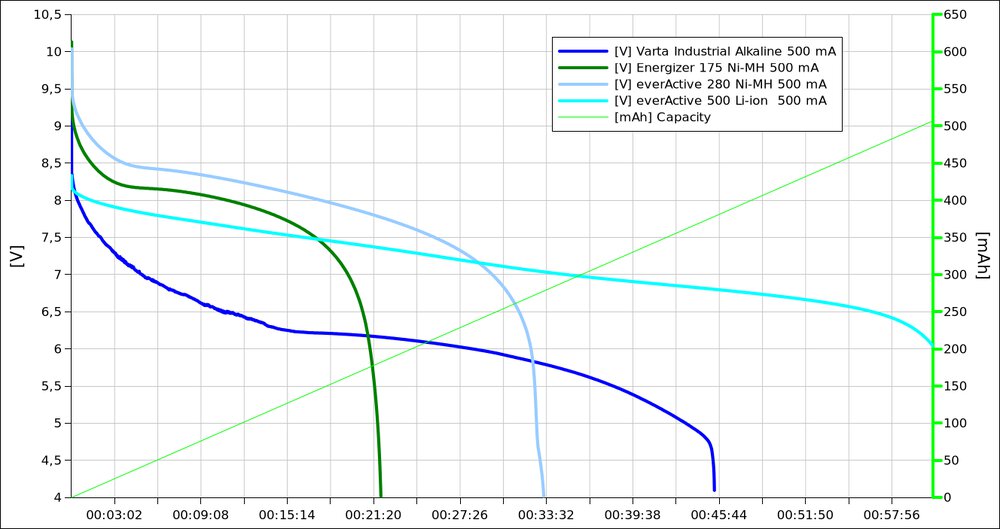
A load of 500 mA is already clearly too much for a typical alkaline battery. All accumulators remain very stable.
Below are graphs showing the dependencies of the achieved capacity and energy values on voltage.
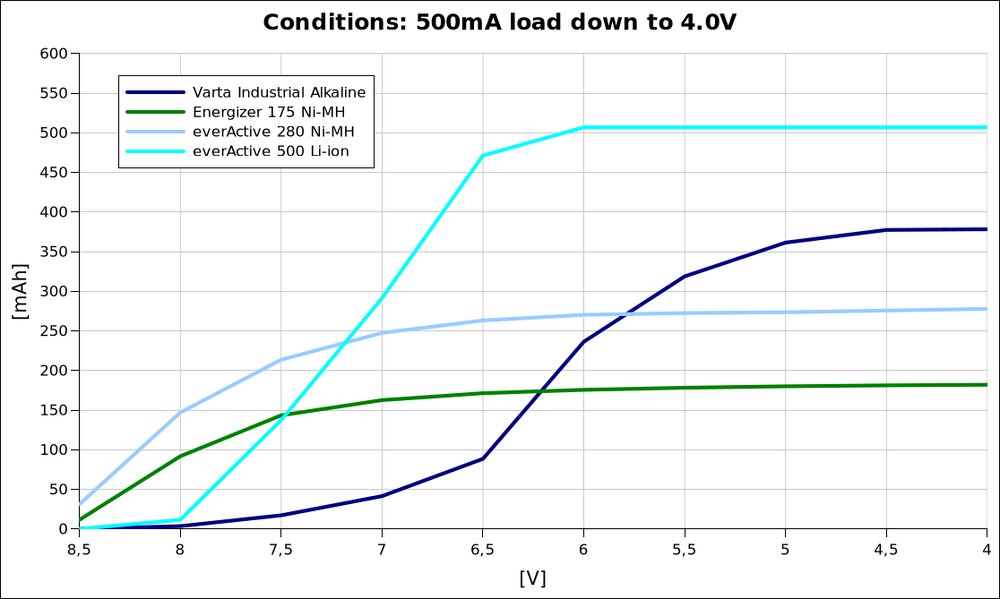
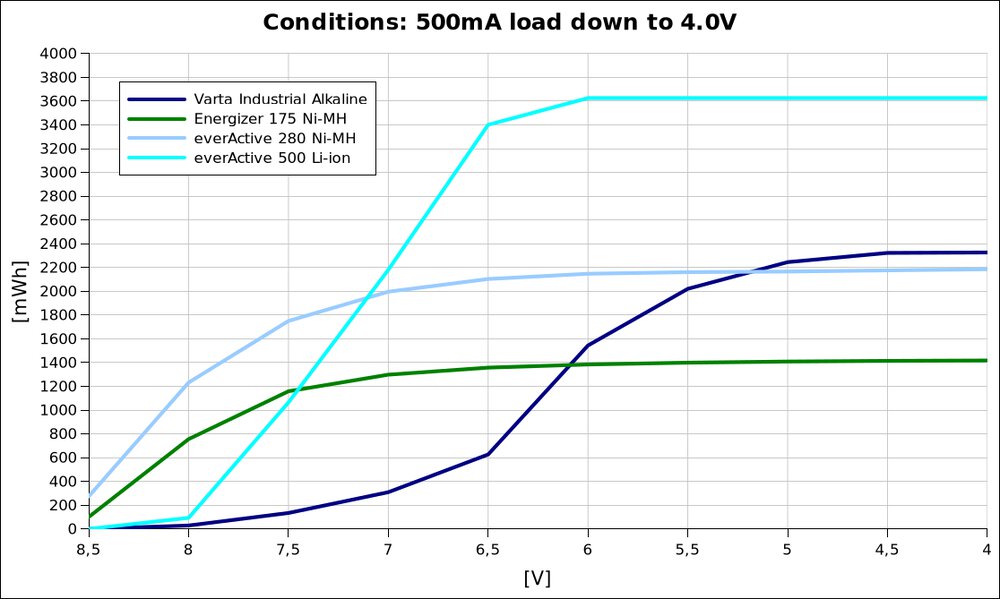
The winner under 500 mA discharge conditions remains the everActive Li-ion accumulator.
The alkaline battery would perform the worst in practical tests when discharging to a level of 7.0V.
Test and results of internal resistance measurement
Less=Better
The lower the resistance, the smaller the voltage drop we have on the battery during operation, which translates to higher current efficiency (higher delivered power).
Results:
1. Li-ion battery: 0.3 Ohm
2. Ni-MH 280 battery: 0.87 Ohm
3. Ni-MH 175 battery: 1.48 Ohm
4. Alkaline battery: 2.03 Ohm
The definitely worst result of the alkaline battery was predictable based on previous performance tests.
The clear winner is the Li-ion accumulator.
Why is there such a difference in operating voltage between Ni-MH accumulators and other cells of the same size?
The alkaline battery, despite its nominal voltage of 9V, offers the lowest output voltage levels in the entire test.
Why?
- For alkaline batteries, the nominal voltage is the starting voltage of a brand new battery, while for accumulators it is the average voltage during operation. We wrote about this in the article: Differences between alkaline batteries and Ni-MH accumulators.
- In the case of 9V batteries, the difference additionally arises from the construction of the battery itself. A typical single Ni-MH 1.2V cell has a similar operating voltage to a 1.5V alkaline battery. Meanwhile, a typical Li-ion 3.7V cell has a similar operating voltage to 3 series-connected Ni-MH cells or 3 alkaline 1.5V batteries.
In a 9V alkaline battery, we have 6 series-connected 1.5V cells, resulting in a voltage of 9V. In Ni-MH accumulators, we usually have one whole cell more - 7 cells of 1.2V give a voltage of 8.4V - in practice, such a battery would correspond to an alkaline battery with a nominal voltage of 10-10.5V.
The 9V Li-ion battery consists of two 3.7V cells connected in series - this corresponds exactly to 6 alkaline 1.5V cells - which is why the Li-ion accumulator has the most similar characteristics to a disposable battery.
Test winner
The undisputed winner of the entire test, taking into account all partial results, is the Li-ion everActive Professional+ Lithium with a capacity of 500 mAh.
It provides the highest compatibility and consistency with a disposable alkaline battery while also offering consistent, very long operating times regardless of application. It maintains stable, high voltage even under high loads. It has the lowest internal resistance among all tested batteries.
The downside is the relatively high purchase cost. However, let us remember that in addition to very high capacity, this accumulator integrates a charger - micro USB connector (does not require the purchase of a dedicated charger for batteries). This accumulator is also the only one in this comparison that has electronic protection against extreme discharge, overcharging, as well as short circuit.
For whom are the other accumulators and 9V alkaline batteries?
Ni-MH accumulators, due to their higher output voltage, work very well in devices that require elevated voltage to operate. Their low internal resistance gives them an advantage over alkaline batteries also in high current consumption devices.
Alkaline batteries perform best with low-demand devices - especially where they last several months between replacements.
Author: Michał Seredziński
Copying the content of the article or its parts without the consent of a representative of Baltrade sp. z o.o. is prohibited.
Batteries and accumulators available at hurt.com.pl
1 x 6LR61 9V battery (R9*) everActive Pro Alkaline (blister)
- PRO ALKALINE is the highest line of alkaline batteries for professional applications
- capacity approx. 650 mAh
- expiry date - 10 years from the production date
1 x 6F22/9V Energizer Ni-MH battery 175mAh 8.4V
- capacity: 175 mAh
- voltage [V]: 8.4
1 x 6F22/9V everActive Ni-MH 320 mAh rechargeable battery ready to use "Professional line"
- the most powerful Ni-MH battery on the market in 9V size
- 1pc - factory consumer packaging - blister
- tested performance - real capacity
- battery pre-charged, new generation made with Ready To Use technology
- highest quality of batteries confirmed by numerous tests
-
Ale super artykuł! Dużo pracy Pan włożył w te badania, ale wynik jest zachwycający ! Szczególnie w zalewie "byle-informacji", które z łatwością można znaleźć w Internecie. Pana artykuł to chlubny wyjątek! Bardzo dziękuję za Pana wkład pracy i chęć podzielenia się z nami!3933
7
0
-
Bardzo fajna analiza porównawcza ale mnie ciekawi skąd biorą się pojemności rzędu 10-12 tyś mAh tych ogniw oferowanych w internecie np. Aliekspress czy Allegro. Chciałbym kupić dobre akumulatorki ale nie wiem gdzie i czym się kierować. Producenci piszą na swoich wyrobach totalne bzdury. To już nie jest chwyt marketingowy a przestępstwwo. Dotyczy to również innych popularnych akumulatorków jak R3 czy R6. Może ktoś odważy się i piwie gdzie kupić dobre akumulatorki które będą miały realne parametry.1319
5
0
-
Na rynku można znaleźć różne akumulatorki najczęściej chińskich marek, pod którymi nie podpisuje się żadna godna zaufania firma/importer.
Producenci, importerzy sprowadzający akumulatorki do EU są zobligowani do spełnienia konkretnych wymagań dot. ich pojemności - pojemności muszą być podane zgodnie z międzynarodowymi normami PN/EN/IEC. Tak stanowi prawo, niestety nie jest przez wszystkich respektowane.
Każdy akumulator AAA z deklaracją pojemności powyżej 1100 mAh, AA powyżej 2700 mAh, czy 18650 powyżej 3500 mAh to na dzień dzisiejszy potencjalne, bardzo prawdopodobne oszustwo.
Gdzie kupić tylko sprawdzone pewne akumulatorki? Oczywiście na hurt.com.pl. Firma Baltrade, właściciel serwisu od ponad 30 lat specjalizuje się w dystrybucji sprawdzonych źródeł zasilania.1329
6
1-
Poprawka, 18650 są już 4000mAh i jest to prawdziwa, przetestowana pojemność.5452
3
0
-
-
-
Właśnie takich informacji szukałem w sieci. Byłem ciekawy jak sprawują się akumulatorki w porównaniu do baterii alkalicznej. Zastanawiałem się czy multimetry zasilane właśnie bateriami 9V będą prawidłowo działały na akumulatorach Li-ion, bo obawiałem się zbyt niskiego napięcia. Teraz już wiem, że bezpodstawnie i śmiało można je zamienić.
Li-ion ma niezaprzeczalną zaletę, że nie potrzebuję dodatkowej ładowarki do Ni-MH 9V ;)969
13
0