
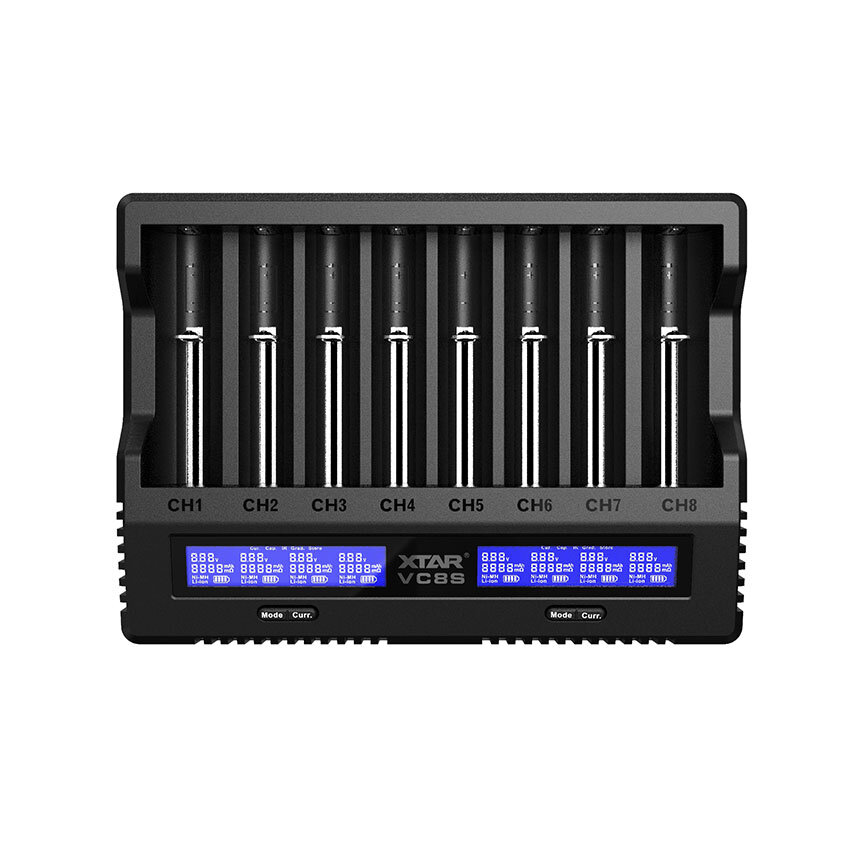
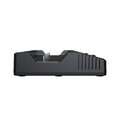
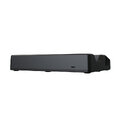
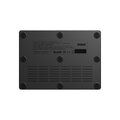


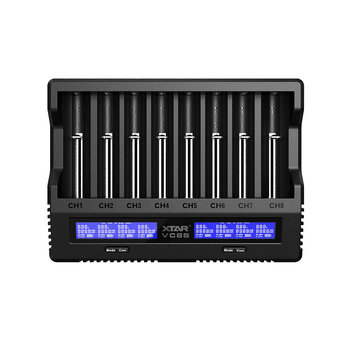
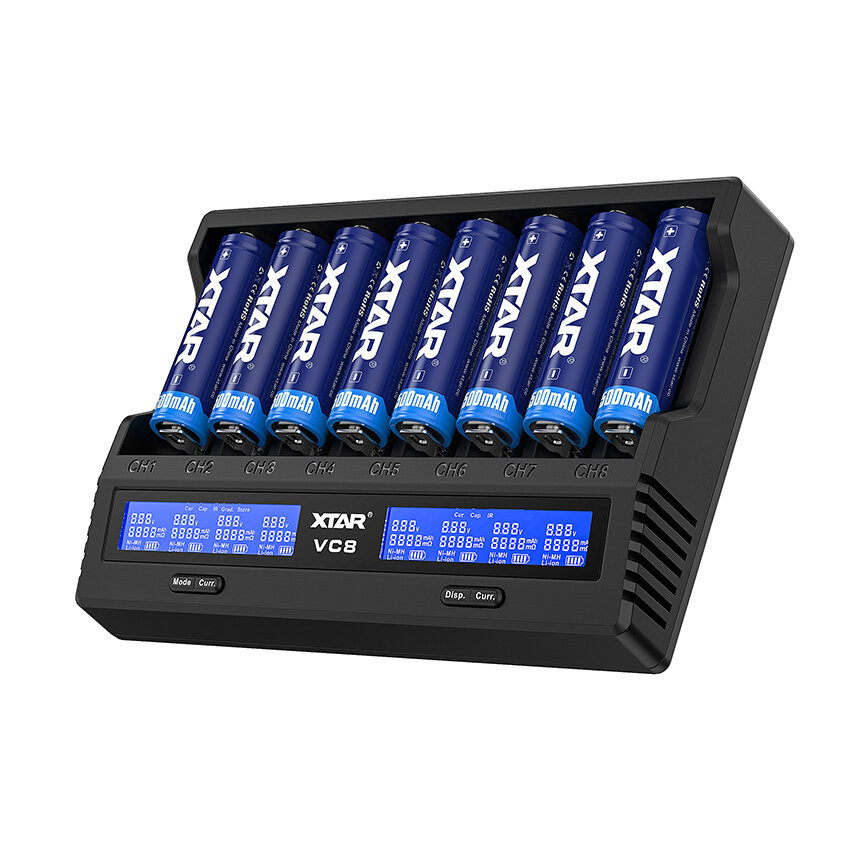
Key features:
- charging Li-ion batteries with a three-stage TC/CC/CV charging process controlled by a processor
- charging Ni-MH batteries using the 0ΔV and -ΔV methods
- eight independent charging channels
- adjustable charging current
- LCD display showing cell voltage, charging current, and internal resistance
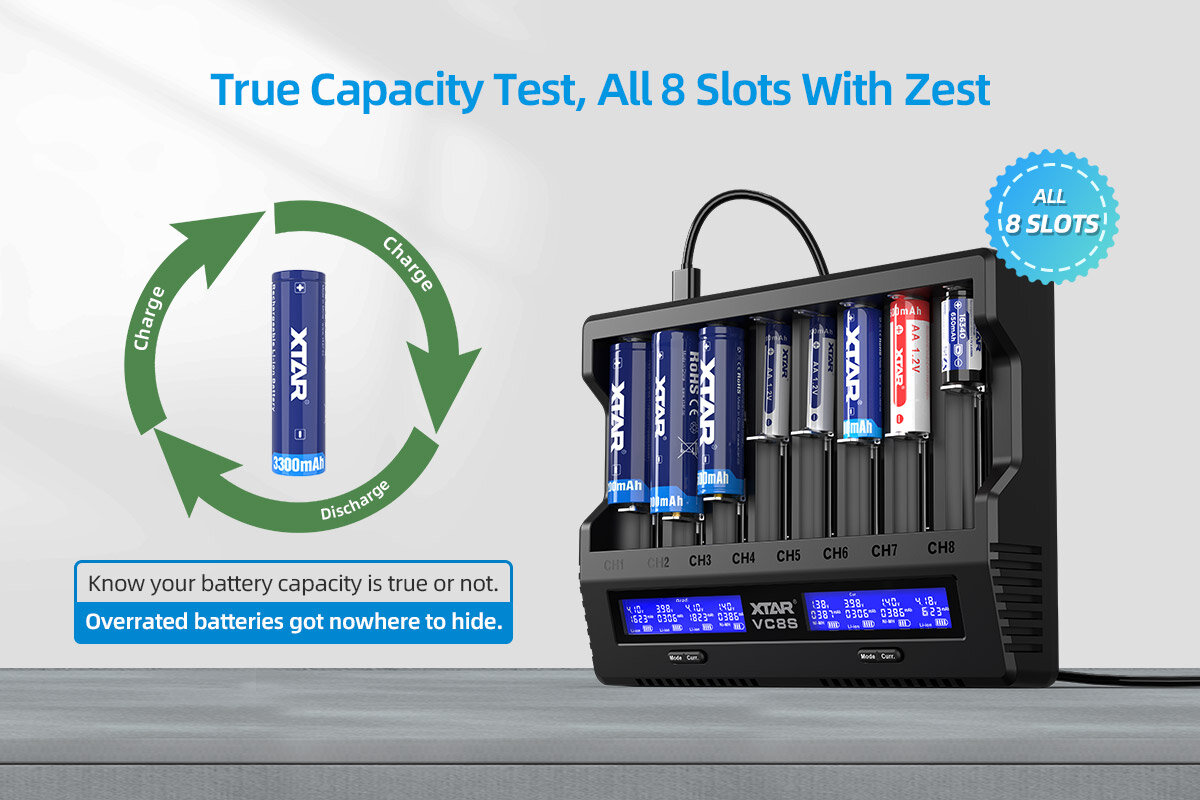
- capacity measurement (from discharge)
- storage mode - for battery storage
- function for reactivating deeply discharged cells
- protections: short circuit, reverse battery insertion, overcharging, and using too high charging current
See full specification.
Xtar is a renowned manufacturer of high-quality chargers for Li-ion batteries, flashlights, and Li-ion batteries. Xtar products are sold in over 120 countries, including the USA, Germany, Japan, and Russia. For the production of Xtar chargers, only the highest quality materials are used - from the casing material to efficient electronics. All Xtar chargers have CE certification required in European markets.
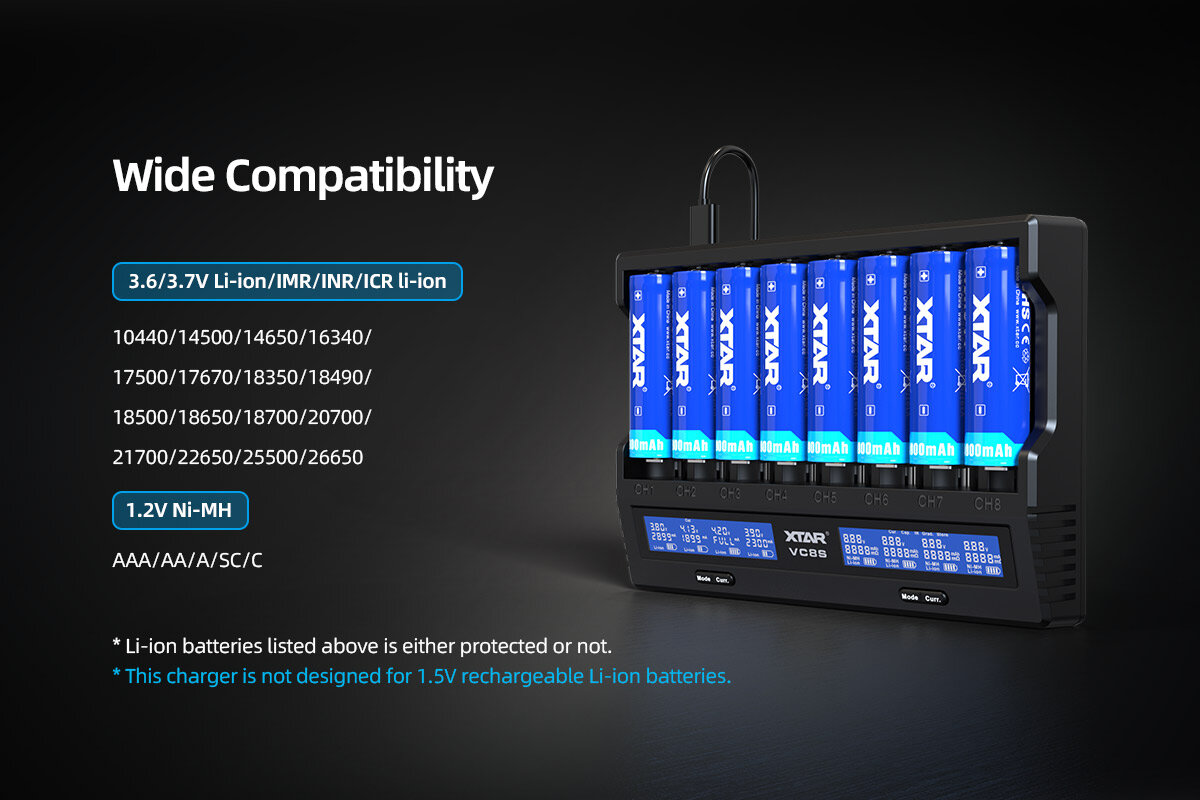
VC8S is an upgrade of the well-regarded and popular VC8 charger. VC8S is a charger with a three-stage TC/CC/CV charging process for Li-ion cells and 0ΔV and -ΔV for Ni-MH batteries. It charges 1-8 Li-ion cells 3.6 / 3.7V and Ni-MH of any capacity in sizes AAA/R03, AA/R6, 10440, 14500, 14650, 16340, 17500, 17670, 18350, 18500, 18650, 18700, 18700, 20700, 21700 - also with protection, 22650, 25500, 26650. In the two extreme channels, it is possible to charge batteries with low internal resistance at a current of up to 3A (only 2 cells).
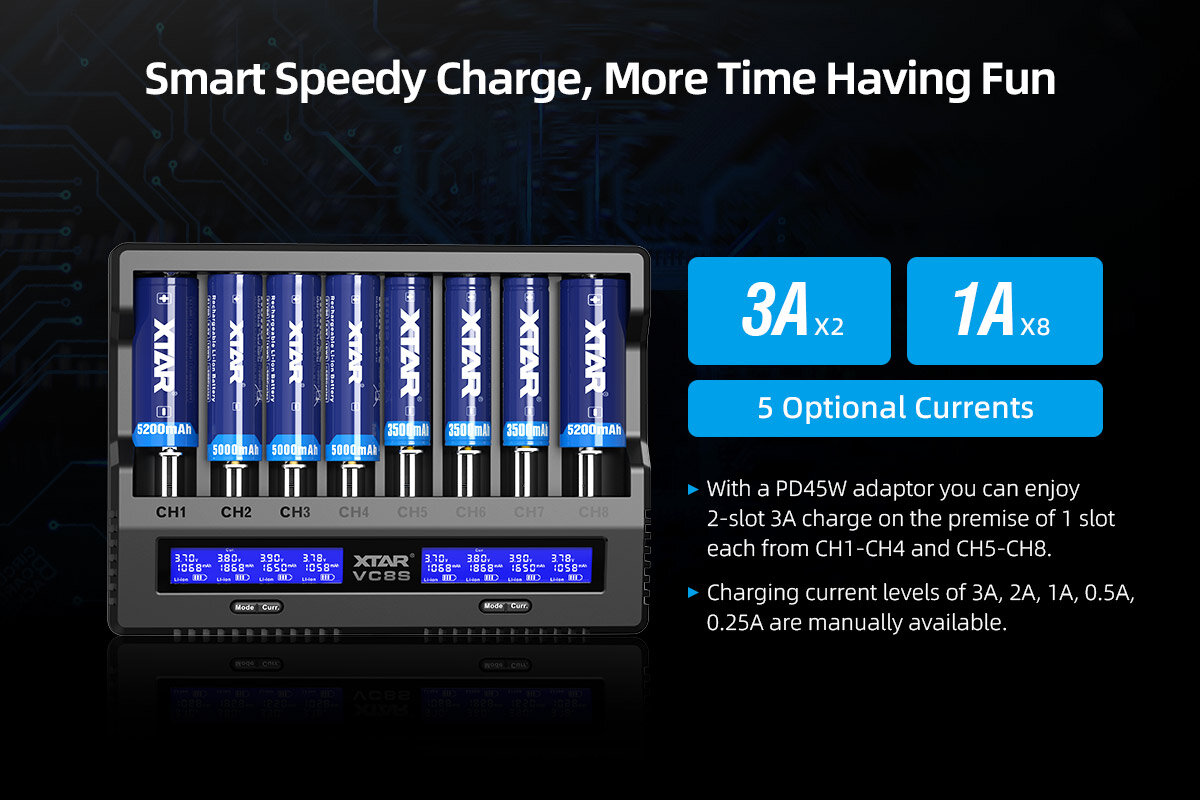
The maximum charging current is 3A and is available only for the two extreme channels and only when the middle channels are not used - at most, the charger can charge 2 batteries simultaneously at this current. In the case of placing 4 batteries, the maximum charging current will be 2A. When placing 8 cells, the maximum charging current will be 1A. This is another difference compared to the regular VC8. The current performance has significantly improved, and charging eight batteries simultaneously at 1A should satisfy even the more demanding users.
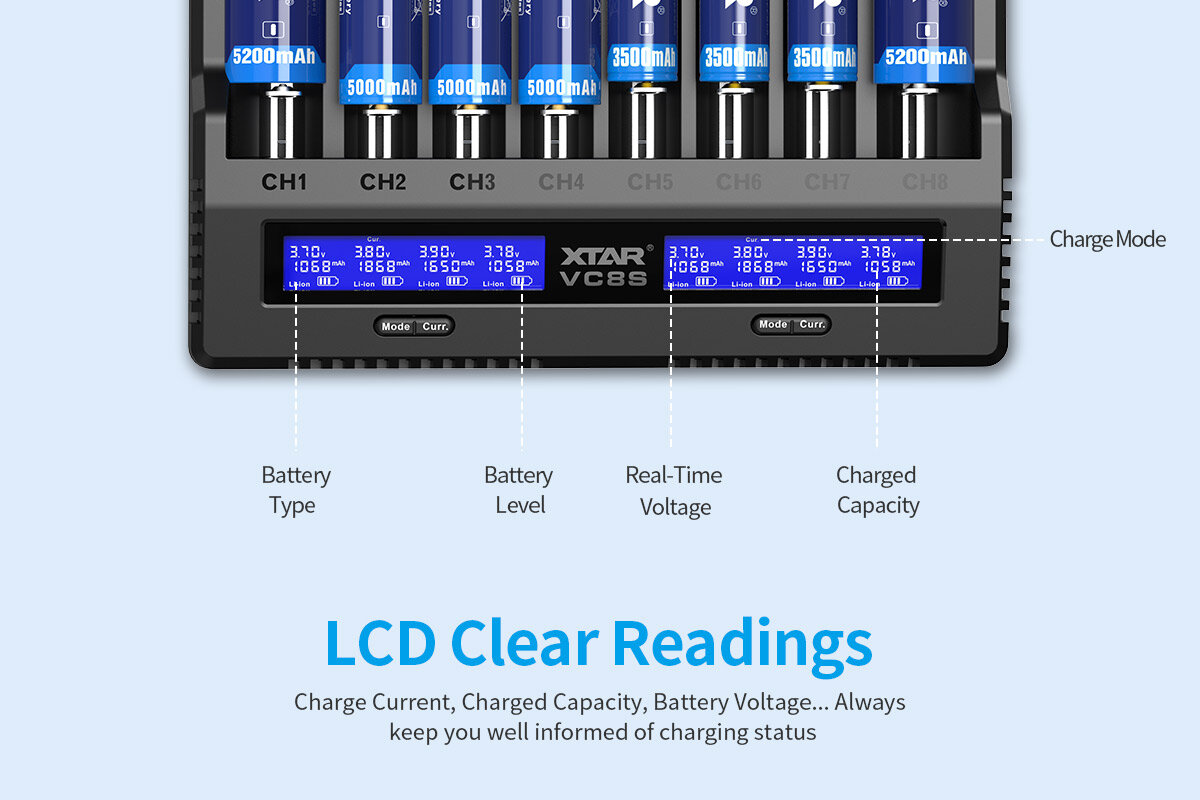
The backlit LCD display of the Xtar VC8S charger continuously shows information about the charger's operating status: voltage of the charged batteries, charging current, charge used to charge the cells, internal resistance of the cells, indicates any errors, and informs when charging is complete. The type of displayed information can be changed at any time by pressing the "disp" or mode button. Switching between charging modes is possible by holding down the mode / display buttons for a longer time. The charging current can be changed at any time to a higher / lower value - the charger measures the internal resistance of the cell and negotiates the maximum (optimal) charging current. To measure the battery capacity, the "Grad" option should be used. After the quality assessment process is completed, the display will show the battery capacity and its internal resistance.
WARNING!
In VC8S, the "storage" and "grad" modes work on all channels! In the previous version - VC8, these functions were only possible on channels CH1-CH4.
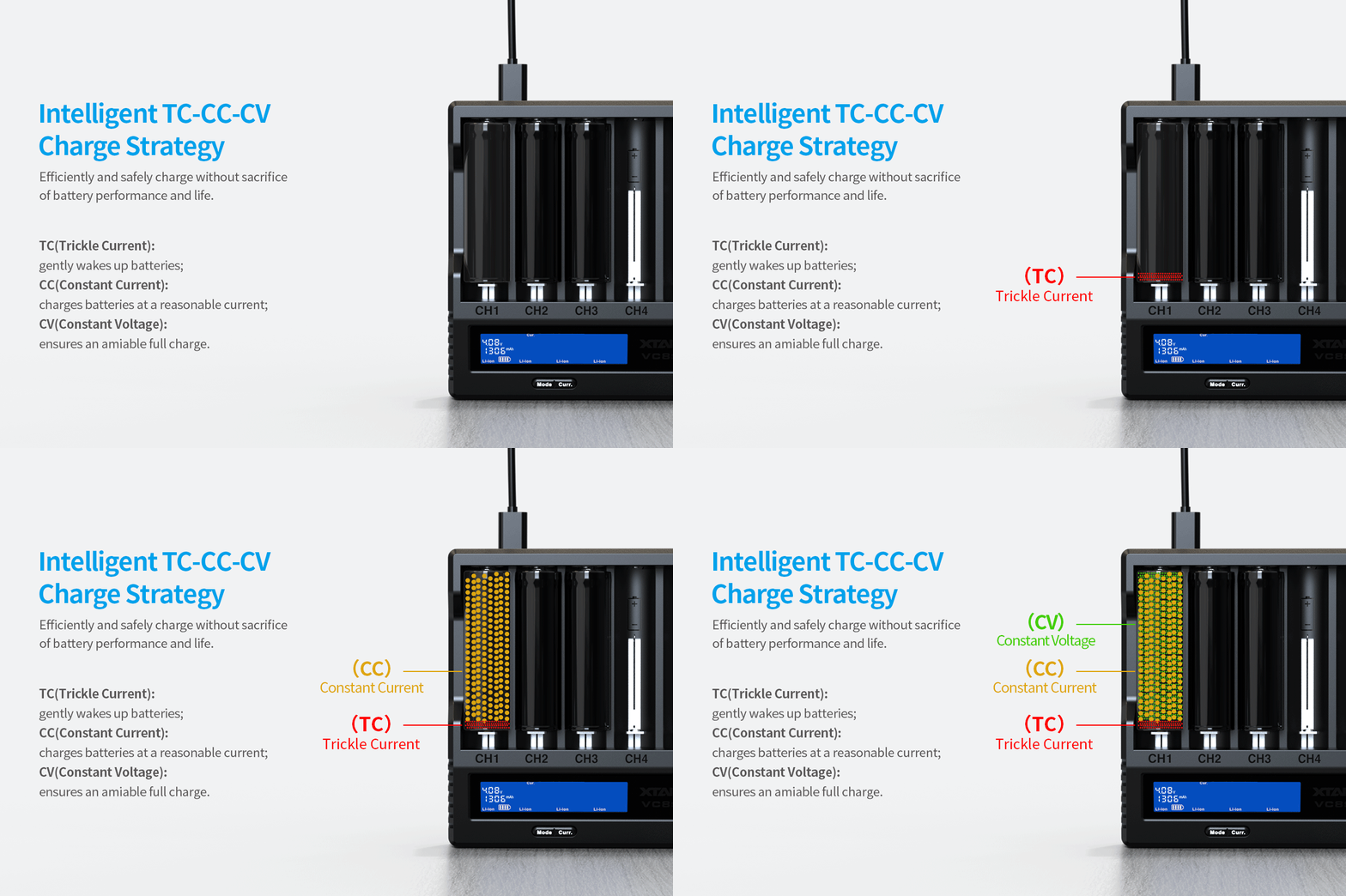
What is the TC/CC/CV charging method? It is a three-stage charging process for Li-ion cells that ensures the cell remains in good condition by charging with the appropriate current at each stage and completing the charging process at the right moment.
The individual stages of the TC/CC/CV process are:
• TC Phase: cells discharged below 2.9V are 'woken up' with a lower current.
• CC Phase: after reaching 2.9V, the cell is charged with a constant current of between 0.25A and 3A (depending on the power source used and the number of batteries being charged).
• CV Phase: when the cell is almost fully charged, the charger switches to charging with a decreasing current until the voltage of 4.2V is reached on the cell. After reaching 4.2V, the charging process is complete - the battery is fully charged.
Batteries left in the charger will undergo a natural self-discharge process. Charging of Li-ion batteries will resume when the voltage on the battery drops below 3.9V. For Ni-MH batteries, charging is not resumed when the voltage drop is due to self-discharge.
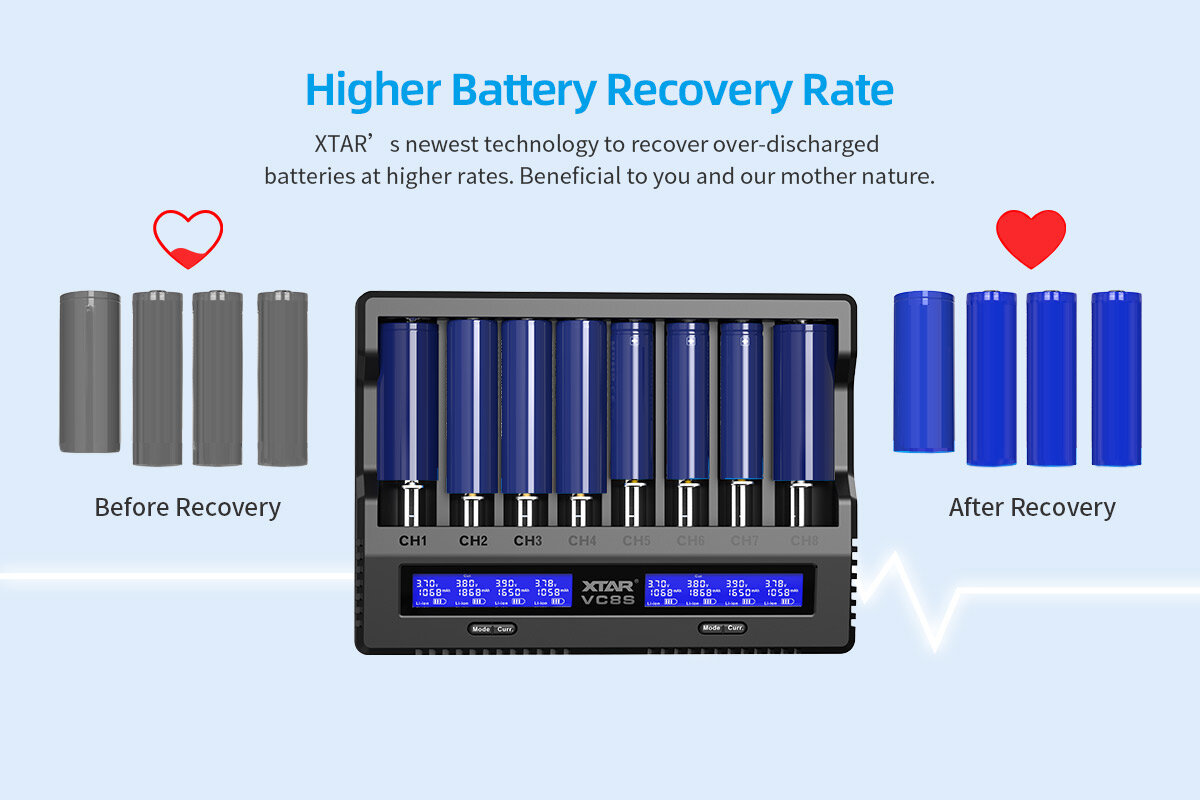
The Xtar VC8S charger has a function for reactivating deeply discharged cells and cells with a voltage of 0V. Many chargers on the market are unable to charge such batteries. Here, the Xtar VC8S charger comes to the rescue, which in many cases allows for the 'rescue' of such cells. Just insert the deeply discharged battery into the VC8S charger, just like with normal charging - the charger will detect the discharged cell and attempt to reactivate it.
Note! Cells discharged below a certain level may suffer irreversible damage, and their reactivation may be impossible. It is advisable to avoid overly deep discharging of Li-ion and Ni-MH batteries - this can lead to a significant reduction in their lifespan and capacity or render them completely inoperable.
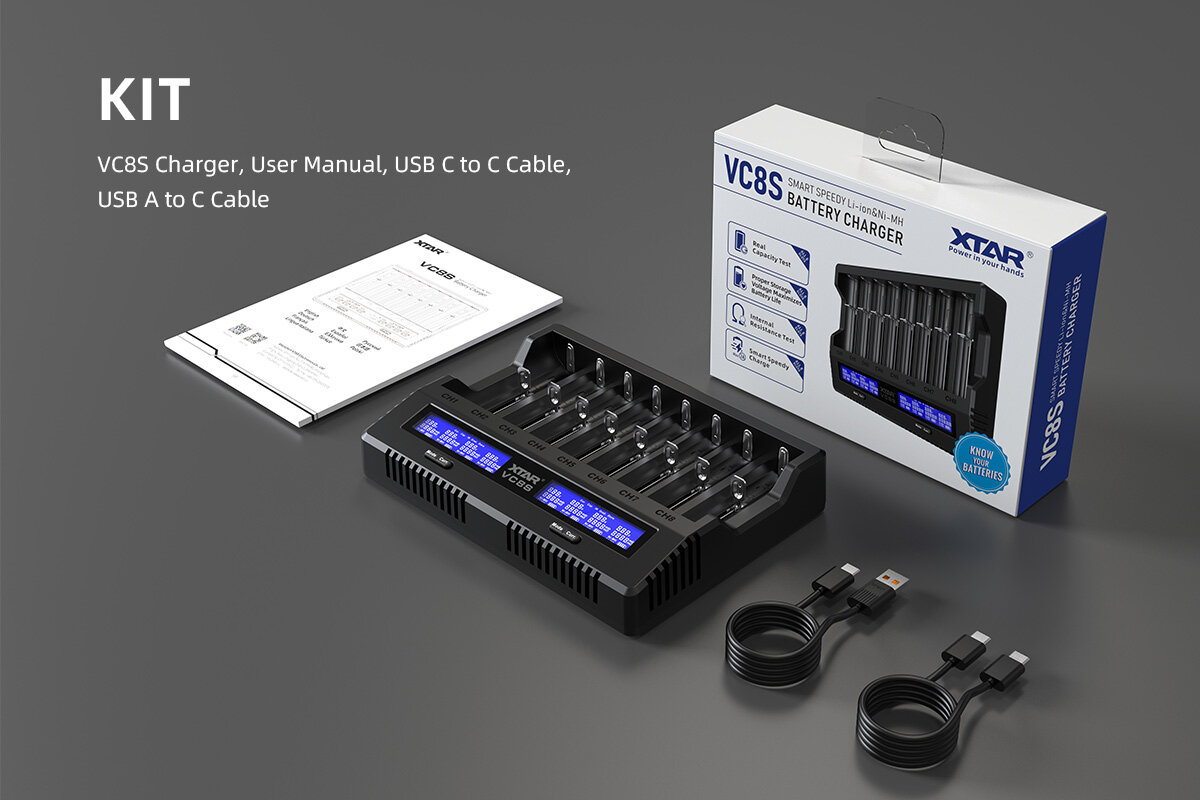
Included with the Xtar VC8S charger is a USB-C - USB-A cable. The power adapter is not included in the set. To power the charger, a charger with QC3.0 standard (9V / 2A) is required. However, to fully utilize the capabilities of the charger, a charger compliant with the PD standard with a minimum power of 45W is recommended. It is possible to use a weaker power supply, the VC8S will adjust the charging current to the capabilities of the power source.
- Li-ion batteries 3.6-3.7V, unprotected
- Li-ion batteries 3.6-3.7V, protected (with PCM/PCB)
- Ni-MH batteries
- QC 3.0 (5V/2A | 9V/2A) - USB Type-C Socket
- PD 2.0 (15V/3A), QC3.0 (5V/3A | 9V/2A)
- Processor-controlled TC/CC/CV for Li-ion
- Processor-controlled CC with -ΔV/0ΔV/PVD for Ni-MH
- 2x 3A (only in one of the two extreme channels 1 and 8) 4x 2A / 8x 1A / 8x 0.5A / 8x 0.25A(Po osiągnięciu 2,9V ogniwo ładowane jest stałym prądem o wartości od 0,1A do 1A (zależnie od wykorzystywanego źródła zasilania )
- Li-ion 4.2V ±0,05V
- Reactivation of deeply discharged cells and 0V cells
- Cell capacity measurement
- Against overload / short circuit
- Before reverse polarity of cells
- Charge
- Grade: charge -> discharge -> charge
- Storage - charging for battery storage
- Measurement of internal resistance in mOhm (Quick test)
- Working/Charging Status
- Charging
- Battery voltage
- Charge used to charge the cells
- Internal resistance of cells
- VC8S charger, USB Type-C cable, user manual
- Li-ion batteries 3.6-3.7V, unprotected
- Li-ion batteries 3.6-3.7V, protected (with PCM/PCB)
- Ni-MH batteries
- QC 3.0 (5V/2A | 9V/2A) - USB Type-C Socket
- PD 2.0 (15V/3A), QC3.0 (5V/3A | 9V/2A)
- Processor-controlled TC/CC/CV for Li-ion
- Processor-controlled CC with -ΔV/0ΔV/PVD for Ni-MH
- 2x 3A (only in one of the two extreme channels 1 and 8) 4x 2A / 8x 1A / 8x 0.5A / 8x 0.25A(Po osiągnięciu 2,9V ogniwo ładowane jest stałym prądem o wartości od 0,1A do 1A (zależnie od wykorzystywanego źródła zasilania )
- Li-ion 4.2V ±0,05V
- Reactivation of deeply discharged cells and 0V cells
- Cell capacity measurement
- Against overload / short circuit
- Before reverse polarity of cells
- Charge
- Grade: charge -> discharge -> charge
- Storage - charging for battery storage
- Measurement of internal resistance in mOhm (Quick test)
- Working/Charging Status
- Charging
- Battery voltage
- Charge used to charge the cells
- Internal resistance of cells
- VC8S charger, USB Type-C cable, user manual
5th Floor, No.77 Xinhe Rd, Shangmugu
518000 Shenzhen
Chiny
Email: info@xtar.cc
Telephone: (+86) 755-25507076
Geodetów 24
80-298 Gdańsk
Polska
Email: contact@baltrade.eu
Telephone: 58 552 20 20